The Australian Vegetable Growers Levy with the Horticultural Research and Development Corporation (HRDC) has now funded a number of Industry Development Officer (IDO) positions in Australia.
Through the foresight of AusVeg, the positions have been initiated through a number of State organizations to facilitate technology transfer and adoption, and give growers the opportunity to participate in decisions about what Research and Development is required for their State or region.
Currently there are seven IDO’s fully or partially funded by the HRDC/Grower levy. The IDO’s meet regularly and keep in touch by ‘phone and email. They have formed the Australian Vegetable Industry Development Group to ensure that all Australian vegetable growers get access the best available information when they need it.
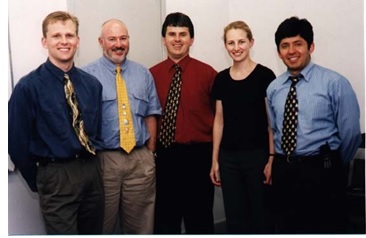
Picture of IDO’s Left to Right David Ellement WA, Craig Feutrill SA, Shane Comiskey QLD, Samantha Bray QLD, Patrick Ulloa Victoria.
There is also Robert Kennedy, Production IDO and Lisa-Huong Nguyen, Marketing IDO, for the Northern Adelaide Plains. These last two positions are based at the Virginia Horticulture Centre and are partially funded by voluntary contributions from the Virginia Irrigators Association, which is matched through HRDC.
New South Wales and Tasmania are currently in the process of employing IDO’s for their State.
The aim of this monthly column is to ensure that Australian vegetable growers are kept up-to-date with what is happening in their and other States. We do not intend to report on Research that is being conducted, but rather on how it is being implemented, meetings, farm visits, grower trials, and issues that need to be addressed. There will be a report from each State IDO where possible.
A list of contacts for all of the IDO’s at the end of this column.
South Australia
The Virginia Irrigators Association and the Horticultural Research & Development Corporation has funding two industry development officer positions at the Virginia Horticulture Centre. As Industry Development Officer, Production my role initially has been to identify grower and industry needs. Over the past six months there has been a lot of time spent talking to growers to identify problem areas and issues that they believe are affecting their industry.
Now the initial talking is over and the dust has settled what are the results? Communication, Western Flower Thrips, marketing and new technology are at the top of the tree as industry concerns and needs. Taking these issues separately what can be done?
You are reading the first step in improving the communication in the region. The story on Western Flower Thrips explains how this problem for our region is being approached. On the new technology front there are two overseas trips planned for grower to see first hand the latest technologies. Israel and Spain in May, for greenhouse production and California and Mexico in July for the broad acre producers.
All this sounds great but I would like to state the obvious this is your industry and if you do not participate in the decision making process you could end up with something that you might not want. Don’t forget a committee designed the first horse and now we have a camel.
Rob Kennedy Industry Development Officer contact (08) 8282 9200
Western Flower Thrips in SA

All vegetable growers on the Northern Adelaide Plains recognise that Western Flower Thrips (WFT) has become a major problem.
A grower based Industry working group has been established in conjunction with the Virginia Horticulture Centre, to develop management programs’ which will lessen the impact of this economically damaging pest on the region.
The working group has approached the Playford Council, who has recognised the impact this pest has had on the region. Working together, the Playford council, the working group, the Northern Adelaide Waste Management Authority (NAWMA) the South Australian Research and Development Institute and Primary Industries (SARDI) and Resources South Australia (PIRSA) are now developing a management program for the Northern Adelaide Plains.
The role of each of these groups is:
- Playford Council has expressed its willingness to work with industry to conduct roadside weed eradication at strategic times of the
- NAWMA are planning the establishment of a green
waste depot located within the region. This will also accept plastic material, and will be the collection point for chemical drums.
- The Entomology Department of SARDI will provide a quick turn-around WFT identification program, which enables the grower better information for a targeted spray program to control the
- PIRSA have developed with the Strawberry Industry of SA, over the past two seasons, a monitoring and control program. PIRSA has developed a training program which is available to all
To maximise the benefit of this support, the industry working group together with the Virginia Horticulture Centre, will identify and implement commercially focussed training programs in the use of sticky traps for monitoring of WFT. Furthermore for this support to be effective on the NAP, there needs to be a total industry approach to controlling this pest.
It is important to recognise that WFT is not isolated to greenhouses, but can effect broad-acre crops as well.
Western Flower Thrips cannot be dealt with by a grower in isolation – it must be an industry approach if we are to have an effect.
IMPORTANT NEWS FLASH:
Branched Broomrape, a declared pest parasitic weed of some vegetables and other crops such as canola, has been identified in the Murray Bridge region. This weed has been in South Australia for a number of years, but all growers should be aware of what it looks like and the impact of it infesting the Northern Adelaide Plains. An area from Bow Hill to Tailem Bend on the southern side of the Murray River has been quarantined with protocols for handling produce that transported out of this area. Information packs, identification sheets and produce handling protocols are available from the Virginia Horticulture Centre.
Victoria
Weather station could benefit all growers
Kon Koroneos, the Victorian Brassica delegate to the National R&D Committee, is taking part in the Lettuce Best Management Project. He is hopeful that researchers will be able to develop a model for tipburn prediction. The weather station that is now operating in Werribee is providing important information to develop a prediction model.
However, Kon thinks that a phone link facility should be installed with the weather station to allow all growers in the region to have access to the weather data. Kon has requested the Industry development officer to seek support from HRDC to complete the installation of the communication devices.
Queensland
The QLD IDO’s working through Queensland Fruit and Vegetable Growers are leading the way in Australia and have surveyed Vegetable Growers from Northern NSW to the Northern Territory. Sam Bray and Shane Comiskey have produced a number of documents that give good direction for the needs of QLD growers. An electronic booklet produced by QFVG included the following information, which I thought merited reproduction.
Race to the check-out: buying patterns for individual vegetables
The vegetables classed as “family favourites” are potato, broccoli, carrots, corn, lettuce, mushrooms and snow peas, but vegetables can also be grouped according to purchasing patterns of consumers:
- The most popular vegetables (those purchased by more than 80% of households at least once a fortnight) are tomatoes, carrots, potatoes and onions, followed closely by lettuce (76%)
- The next group of vegetables are broccoli (41%), cucumber (38%), capsicum (37%) and pumpkin (36%) followed by beans, zucchini and celery which are bought weekly by approximately a quarter of the sample households and fortnightly by another 25%
- Cauliflower, cabbage and corn are bought by a minority of the sample group (there appears to be a preference for frozen corn which consumers say tastes better)
- Asparagus, Brussels sprouts, Chinese vegetables, fresh herbs, parsnip, egg-plant, silver beet, snow peas, button squash and sweet potato are bought by small numbers of consumers, but there are high numbers who never buy them
- Salad vegetables are more popular in summer while cauliflower, potatoes, pumpkin, broccoli, parsnip and Brussels sprout have a higher winter usage
List Of Contacts:
South Australia
Craig Feutrill, SA Vegetable Industry Development Officer, South Australian Farmers Federation PO Box 6014, Halifax Street, Adelaide, SA 5000, Phone (08) 8232 5555, Fax (08) 8232 1311
Mobile 0418 831 089, Email feutrill@world-link.com.au
Robert Kennedy, Production Industry Development Officer, Northern Adelaide Plains, Virginia Horticulture Centre
PO Box 847, Virginia, SA 5120, Phone (08) 8282 9200, Fax (08) 8380 8950, Mobile 0414 983 807
Email RKennedy@virginiahc.com.au
Lisa-Huong Nguyen, Marketing Industry Development Officer, Virginia Horticulture Centre
PO Box 847, Virginia, SA 5120, Phone (08) 8282 9200, Fax (08) 8380 8950, Mobile 0416 255 551
Email virghc@chariot.com.au
Victoria
Patrick Ulloa, Victorian Vegetable Industry Development Officer
Phone (03) 9738 0574, Fax (03) 9738 0573, Mobile 0409 403 676, Email pulloa@vgavic.org.au
Western Australia
David Ellement, WA Vegetable Industry Development Officer, MP 96, Market City, 280 Bannister Road, Canning Vale, WA 6155. Phone (08) 9456 4077, Fax (08) 9455 2096, Mobile 0408 941 318 Email element@iinet.net.au
Queensland
Samantha Bray, QLD Vegetable Industry Development Officer, Brisbane Market, PO Box 19, Rocklea, QLD, 4106, Phone (07) 3213 2444, Fax (07) 3213 2480, Mobile 0408 135 042
Email sbray@qfvg.org.au



 shanecomiskey